
Industrial Construction Services
Dock Aprons and Loading Zones for Pueblo Buildings
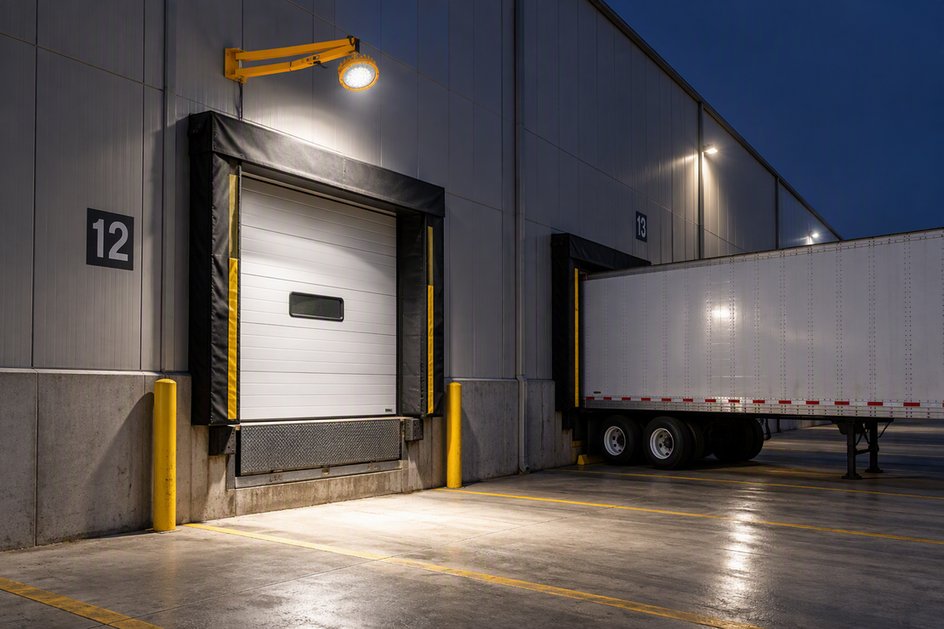
The first thing to fail on a loading dock is almost always the concrete in front of it. Trailer landing gear sits on the slab with thousands of pounds on a few square inches, trucks brake and turn on the same spot ten times a day, and the apron slope that was meant to shed water ends up holding it. We pour dock aprons to survive that, with thick, doweled, reinforced concrete laid on a proper base.
A dock apron sits between the truck court and the building, and it is the most heavily loaded pavement on the site. Its grade must match the dock door elevation, the leveler range and the trailer bed height, so that a forklift can drive onto a trailer without a bump. Too steep and the trailer rolls, too flat and water runs into the building.
Our approach is simple: build the apron as a structural slab. We set the subgrade, place a stable base, install dowels at joints, cast the concrete in carefully planned panels and finish it for traction and drainage.
What the apron work includes
Scope runs from subgrade to striping. We prepare the base under the apron and the approach, form and pour the slab with reinforcing, install dowel baskets or plates at construction joints and cut control joints at the right spacing. Dock pits, levelers, bumpers and edge angles are coordinated with the dock equipment supplier, and the slab around them is poured to match. The apron connects to the truck court or trailer yard with a joint detailed for movement.
Details include trench drains where water would otherwise cross a lane, bollards at doors and corners, wheel guides, light-duty and heavy-duty transitions, and sealants in joints. Every one of these is a place where an owner later pays for what was left out.
Elevations, slopes and trailers
A dock height is generally set between 48 and 52 inches for standard trailers, and the apron falls away from the door at a limited slope. Those dimensions interact with leveler ranges, door heights and site drainage. We lay out the grades on a sheet before any dirt is moved so the surveyor, the dock supplier and our concrete foreman all use the same numbers.
Apron depth is another decision. A deeper apron gives drivers room to straighten a trailer, but it adds concrete and area. Owners of a warehouse building planning for 53-foot trailers generally want a deep dock approach, and cross-docks want a lane layout that supports door-to-door movement.
How we manage the concrete
We manage the concrete placing and finishing as one scope, which means the superintendent at the apron is the same person who oversaw the foundations and floors. That continuity means the dock pit, the building slab and the exterior apron meet at the right levels. If the building contract includes refrigerated dock retrofits, we also coordinate vapor barriers, insulation and thermal breaks at the doors.
Placement matters. We choose mix designs with the supplier to suit the season, adjust for temperature and wind, and cure the slab thoroughly before it takes load. Panels are sawed on time, since early sawing is the best insurance against random cracking.
Tolerances matter at the edge of the building. Dock pits are set to survey, and the apron is poured to a template so the slope at the door lands within a small tolerance. Dock levelers have a working range, and a few inches of error in the approach can leave a door that no leveler can serve. We check the finished grade at every door with a level and record it in the closeout file.
Finally, we think about the next ten years of wear. Joint sealant is installed after the slab has dried and shrunk, bollards are set in sleeves for easy replacement, and the surface is finished with a broom texture that gives traction without chewing up tires. These are small items that keep a dock in service.
Where dock work shows up in this valley
The metro's roads set the pattern. State Highway 45 (Pueblo Boulevard) is a 9.126 mile expressway running from I-25 exit 94 in south Pueblo north to US 50 in Pueblo West, and buildings along the Pueblo Boulevard corridor depend on trucks arriving from I-25. Pueblo West has a North Industrial Park, and the US 50 corridor connects it to the interstate.
On the redevelopment side, PuebloPlex tenants include manufacturing, warehousing, distribution and rail car storage and maintenance. A campus with that mix needs docks of many kinds, from conventional truck doors to heavy equipment bays, and aprons that tolerate wheels and tracked loads.
Where people get hurt on docks
Dock work puts forklifts, pedestrians and trucks in a small space. Aprons should have clear lines, pedestrian crossings, wheel chocks or vehicle restraints and enough lighting to see the edge of a leveler at night. We coordinate with your safety lead and with the dock equipment installer so the system as built matches the system designed.
Ice is the winter hazard. A properly sloped apron drains water before it can freeze, and we avoid ponding at door thresholds. Snow removal equipment needs room to work, so we place bollards and curbs with plow clearance in mind.
Pieces that connect to the apron
Drainage, lighting and ADA routes surround the dock. We coordinate with site concrete and ADA compliance for employee paths and accessible parking that connect to the building without crossing the truck lanes.
Owners in logistics and distribution often add docks as volume grows. We design the apron so that more doors can be added without tearing up what is already poured.
Tell us what backs into the building
Send the dock count, the trailer types and the door elevations. We will check the apron slope, the slab section and the approach before the first pour.
Questions and Answers
How thick should a dock apron be?
Thicker than ordinary pavement, typically with reinforcement and dowels at joints, and sized for landing gear loads. The engineer designs it from truck weights, trailer count and subgrade strength. We build to that design and flag places where the plan appears thin for the loads.
What slope is right at the dock?
Enough to drain, but not so much that trailers drift. The apron generally slopes away from the building at a gentle grade, and the dock levelers are designed to handle the difference between trailer bed and door height. We verify the final grades with a survey before the pour.
Can you pour new aprons around an existing building without stopping shipments?
Often, by phasing. We pour one section at a time, keep other doors open and use temporary routes. The concrete needs time to cure before trucks use it, so we schedule the pours around your shipping pattern and sometimes use high-early-strength mixes to shorten the closure.
What causes dock aprons to fail?
Weak subgrade, thin sections, poor joints, standing water and landing gear loads. Most failures come from a mix of these. We address all of them in the design and construction instead of relying on thickness alone.
Related
Ready to talk about your project?
Tell us about the site, the heaviest loads and the date that matters. We will review the scope and follow up with next steps for your Pueblo project.