
Industrial Construction Services
Site Concrete and ADA Compliance for Pueblo Industrial Sites
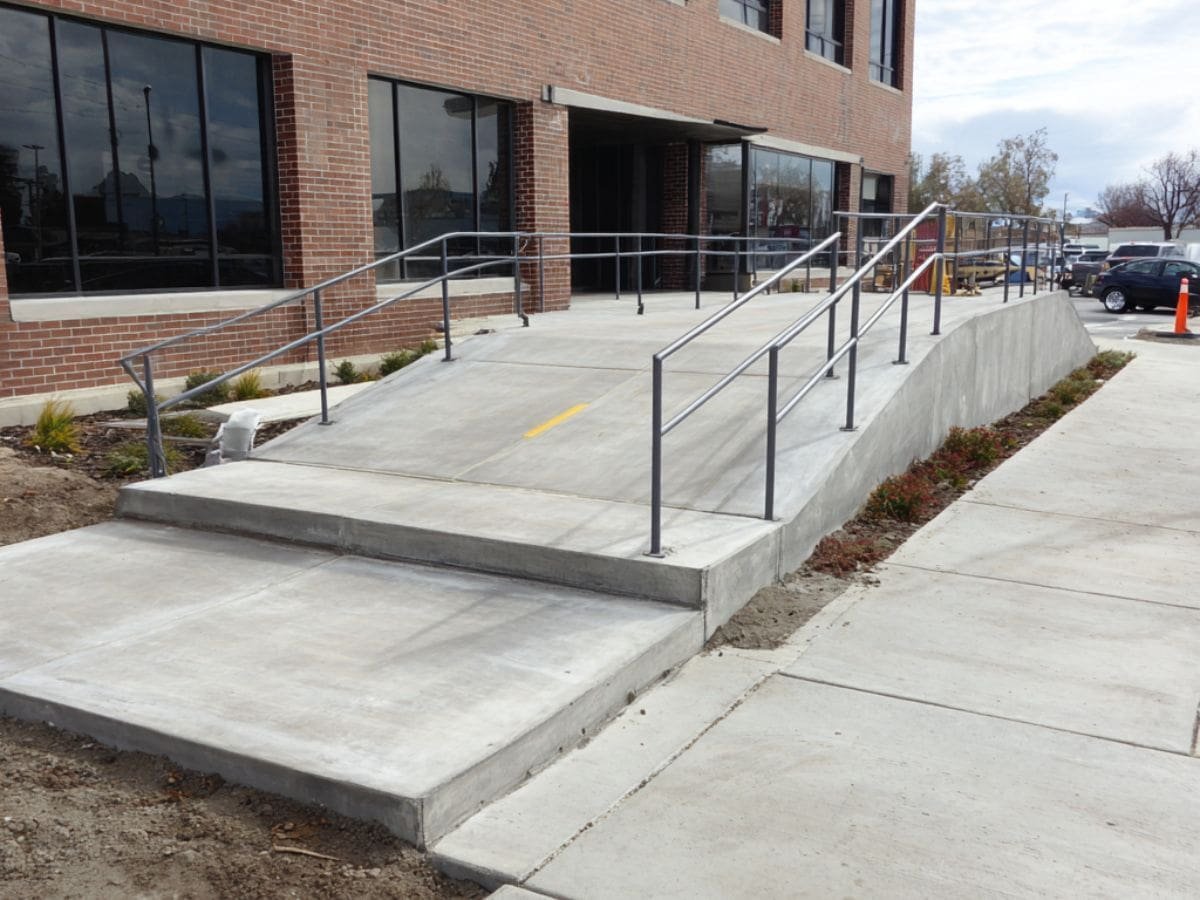
Slope is the whole game in site concrete. A sidewalk that runs a little too steep, a curb ramp with a lip, an accessible stall whose cross slope is off by a point or two: each of these looks fine from a pickup and fails with a digital level. Industrial plants have the added problem of heavy trucks crossing the same concrete that employees use as an accessible route. We build site concrete and ADA-compliant routes for plants in Pueblo and the Arkansas Valley that pass inspection and hold up under the traffic.
Most accessibility mistakes are made in grading, not in forming. The route from the accessible stall to the front door has to hold its running slope and cross slope across the whole distance, and the stall itself has to be nearly level. That means the lot, the sidewalk and the door threshold are decided together. We bring surveyors into the earthwork early so the final concrete is a verification, not a surprise.
Industrial sites bring a second layer of design: forklift crossings, truck turning paths, bollards, wheel stops and dock approaches. We draw the accessible route around those, not through them.
Where accessibility meets heavy industrial traffic
An office entrance on a plant lot may sit fifty feet from a truck court. The accessible route has to be clearly separated from truck paths, either by distance, curbs or bollards, and it has to cross the drive lane at a marked crossing. Truck loads break thin sidewalk concrete, so crossings get thicker sections and reinforcement. Detectable warning surfaces are set in the fresh concrete, not cut in later.
In Pueblo, freeze and thaw cycles are another factor. Concrete exposed to winter moisture and deicing salts needs the right air content and finishing. A slick broom finish at a ramp is a hazard in ice, and a rough one is hard on wheelchairs. We pick the finish for the use, and we place control joints so slabs crack where they should. Joints are laid out around the ramps and landings so a crack never runs through a surface that has to stay smooth, and we saw them early, before shrinkage makes the decision for us.
Who reviews it and under what rules
Commercial codes in Colorado are adopted city by city and county by county rather than as one statewide code, and a published tracker of adopted editions shows different jurisdictions on different editions of the I-codes. In Pueblo, the Regional Building Department lists the 2021 IBC and related codes among those currently in effect, and the County Building Division enforces 2021 International Code Council codes with its own Title 15 amendments. Your site's jurisdiction decides who inspects it.
The city lists commercial approvals as currently taking about 75 days, so accessibility details need to be right at submittal. We prepare a route plan, slope callouts and detail sheets for ramps and stalls. Our lot work, including stabilized parking lots, carries those same details so the paving and the concrete agree.
Flatwork we build
Our site concrete scope includes sidewalks, curb and gutter, curb ramps, accessible stalls with access aisles, truck aprons, dumpster pads, bollard bases, pole bases, equipment pads and slab edges. We supervise the forming, placing, finishing and curing of all of it, with close attention to the finishers on the ramps, because ramp finishing is the part inspectors look at first. We also handle the small items that get missed: pipe bollard sleeves, signage post footings, truncated dome plates and the thickened curb at a drive entrance. For plants, we also pour thickened edges at crossings and reinforce heavy-traffic sections with rebar or mesh.
We coordinate with the building contractor on the threshold. The level landing at an entry door must be set to the finished floor, and a flaw there is hard to fix. If the building scope is not ours, we survey the finished slab and tie in. For office buildings attached to a plant, the entry sequence is a big part of what an inspector walks.
Timing site concrete with the rest of the job
Site concrete goes in late, after underground utilities and most building work, and it can hold up the certificate of occupancy. That makes it a schedule risk. We pre-form where we can, order concrete for a firm pour date and keep a backup plan for hot or cold days. In Pueblo's winter, we use blankets, heated enclosures or accelerators when needed.
We also plan for curing. New concrete should be protected from heavy loads for several days, and a plant needs to know which route stays closed. We tag and barricade new sections and publish a reopening date to your shipping staff so no loaded truck crosses a green slab. When the plant cannot close a route, we pour in halves so one lane stays open while the other cures, even though it costs us an extra mobilization.
Plants and offices that use this work
Every industry with employees on site needs an accessible route, and every one of them has trucks too. Plants in food and beverage often add washdown pads and drains beside the accessible route. Pharmaceutical and life sciences sites tend to add stricter visitor entrances and cleaner finishes.
Public and mixed-use projects around downtown, including those in the Union Avenue historic district, bring older sidewalks, steep grades and existing structures into the accessible route puzzle. We survey what is there, price the fix and tell you what can be made compliant and what cannot.
Get the route right before the concrete is poured.
Send us the site plan and the entrance layout. We will mark up the routes, give you a concrete scope and price, and help you through the review.
Questions and Answers
What are the key slope numbers for an accessible route?
Running slope on a walk is generally limited to 5 percent, cross slope to 2 percent, and ramps to 8.33 percent with landings. Accessible stalls and aisles should not exceed 2 percent in any direction. We hold a tighter target in the field so normal concrete variation still passes.
Who verifies slopes before the concrete is poured?
We do, with a surveyor or a digital level on the formwork, and we check again after the pour. Fixing a ramp after the fact is expensive. We prefer a short delay to correct the form over a long delay to saw-cut and replace a finished slab.
Can you retrofit an older plant to meet accessibility requirements?
Usually. We survey the existing route and write a scope that fits the budget and the risk. Some conditions are cheap to fix, such as curb ramps and stall markings. Others, like steep grades or old stairs, need more work, and we explain the options.
How thick should concrete be where trucks cross a sidewalk?
Thicker than a regular walk, and reinforced. The exact section depends on the axle loads and the subgrade, and we design it with the lot's pavement thickness in mind. Crossings are the first places to crack, so we spend extra effort there.
Does the 75 day review time include accessibility checks?
The city lists commercial approvals as taking about 75 days in general. Accessibility items are part of plan review, so a complete drawing set at submittal avoids a second round. We prepare the site plan with all slopes and details marked.
Related
Ready to talk about your project?
Tell us about the site, the heaviest loads and the date that matters. We will review the scope and follow up with next steps for your Pueblo project.