
Industrial Construction Services
Equipment Pads and Machine Foundations in Pueblo
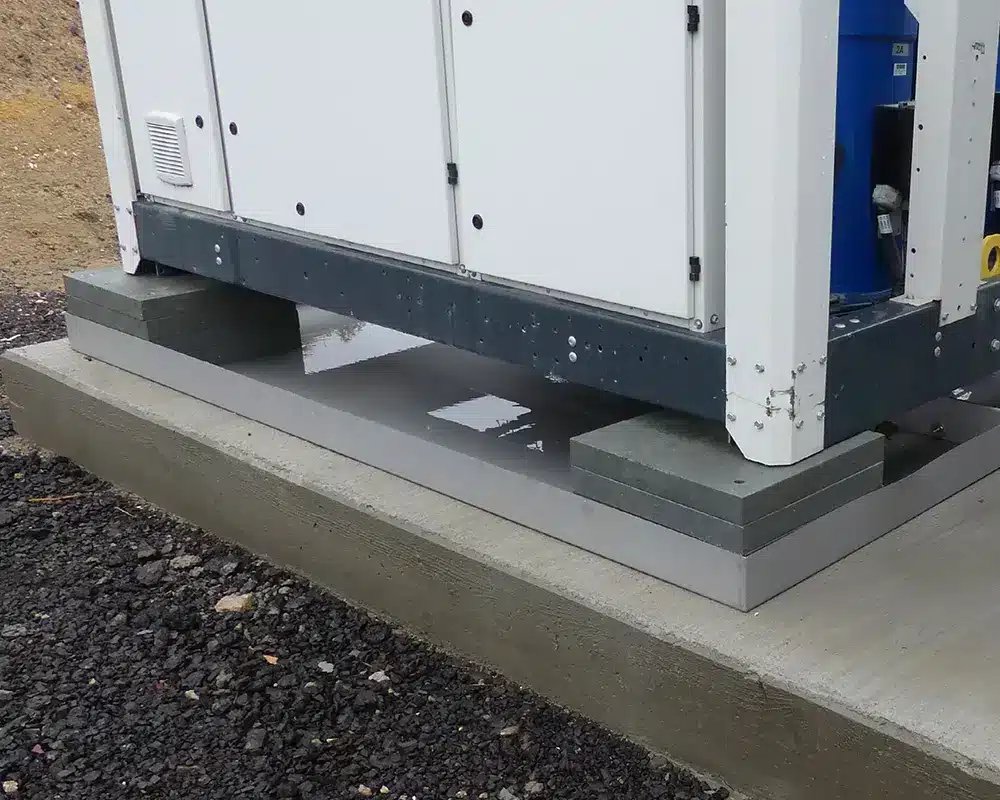
Equipment pads outlast the equipment sitting on them. A press, a furnace, a compressor skid, a rolling mill stand or a cooling tower will be replaced two or three times while the foundation under it keeps working, if it was built right. We build equipment pads and machine foundations for industrial plants in Pueblo and the Arkansas Valley, from a simple housekeeping pad for a pump skid to a mass concrete block for heavy rotating equipment.
Pueblo's mill district has worked on these foundations for a long time. The steel works on the south side began producing on April 12, 1881, and the electric-furnace steel, rail, rod, bar and seamless tube mills remain in operation. Every machine in a place like that sits on something, and the something has to carry weight, vibration, heat and sometimes molten metal. New equipment added to old ground is the common case, and that makes investigation as important as design.
We build the pad to the vendor's drawing and the geotechnical report. When either one is missing, we say so before we pour. Plant managers get a plain list of what we need: the machine weight and footprint, operating and dynamic loads, anchor bolt pattern, grouting requirement, elevation of the top of pad, utilities that come up through it, and the date the machine arrives. Missing any of those is how a pad ends up chipped out and redone.
Old mills, new lines and heavy ground
Industrial work in Pueblo is often a mix of new lines inside old buildings. A long-rail mill that can roll rails up to 480 feet long, up from an earlier 80 foot limit, calls for foundations and support structures at that scale, and similar upgrades happen in smaller plants. The mill district has buried tunnels, old foundations and utilities that are not on any current drawing.
Newer sites on the east side, including PuebloPlex, where a 150,000 square foot rocket motor and propulsion complex is under construction, are cleaner ground but come with their own demands: precise tolerances, special embeds and tight schedules. Whether old or new, we survey, scan and pothole before we dig. In the mill district we assume there is something buried that nobody drew, and we treat the first foot of every excavation as an investigation, not production digging. That habit has saved plants more than one cut cable and one burst line.
Pads, blocks, pits and trenches
Our scope covers housekeeping pads, mass concrete blocks, pump and compressor bases, turbine decks, tank rings, trench and sump work, pits for press and casting equipment, and containment curbs. We handle excavation, shoring, subgrade improvement, formwork, reinforcing steel, embeds, concrete placement and grout. We also set and survey anchor bolts to the template, since a bolt that is half an inch off is a field problem the vendor will not forgive.
Reinforcing is detailed for the actual loads: heavy mats top and bottom for mass blocks, extra steel around pits and openings, and dowels into existing floors so a new pad and an old slab act together instead of fighting. Grout is where many pads fail. Machine bases are leveled on shims, packed with non-shrink or epoxy grout, and cured per the vendor's instructions. We supervise that work closely so the equipment manufacturer's rep sees a base that is ready for setting, with a surveyed top and clean bolt threads.
What we manage directly
We schedule and inspect formwork, rebar, embeds and concrete, which matters on foundations where the placement sequence and the pour temperature affect the result. For mass pours, we plan the placement in lifts, control the heat of hydration and monitor internal temperatures so thermal cracking does not become a defect.
Neighboring work can be added to the same schedule. We pour the industrial floors around the pad, set steel columns on piers and tie into deep foundations and piers where the load calls for them. One plan, one schedule and one accountable contractor for the whole footprint.
Fitting pads into a shutdown window
Equipment foundations are often the critical path of an outage. The old equipment comes out, the pad gets demolished or modified, the new base is poured and cured, and the new machine is set. If any step slips, the plant loses production days. We build a minute-by-minute plan for shutdown pours, including concrete supply backup, pumps, crane access and curing.
In shutdown work we are plainspoken about risk. Concrete takes time to gain strength, and rushing it with accelerators or heating has trade-offs. We tell your operations lead the earliest date that the engineer will accept, and we tell you when a pour needs to be done earlier to protect that date. Cold or hot weather changes the curing plan, and we carry blankets, chillers or shade as the day requires. Structural steel erection often follows right behind.
Hot work, confined spaces and live plants
Foundation work in operating plants means excavations next to live equipment, confined space entry in pits, hot work near forms and traffic from cranes and forklifts. We follow your lockout, permit and orientation systems, and we add our own: shoring plans, excavation inspection, rebar caps and fall protection at open pits.
For owners in metals and heavy industry and utilities and power, we adapt to site-specific rules for high-voltage areas, hot metal and rail traffic. We expect to be told the rules, and we ask when we are not sure.
Send us the vendor drawing.
Give us the equipment submittal, the geotechnical report if you have one, and your outage dates. We will review it, flag questions and price the foundation.
Questions and Answers
How thick should a machine foundation be?
It depends on the machine, its weight, its speed, the soil and the vibration limits. Vendors give a minimum, and many foundation designs go beyond it. We work from the vendor's drawings and the geotechnical report, and we involve a structural engineer for dynamic equipment.
What about old foundations that are in the way?
We locate them with records, ground scanning and test pits. Some can be reused with load checks, some have to be demolished and some can be buried. We price the demolition and the disposal as separate items so you see the real cost of the old ground.
How do you set anchor bolts accurately?
With a steel or plywood template that matches the vendor's drawing, set from survey control and checked again before the pour. Bolts are tied to rebar and protected from displacement during placement. Surveying them after the pour gives you a record the equipment installer can use.
Can you pour a foundation during a short outage?
Often. It takes planning: precast elements, quick-setting mixes, early-age strength testing and multiple crews. We tell you what is realistic and offer a staged option if the window is too short.
What is the difference between a housekeeping pad and a foundation?
A housekeeping pad lifts equipment off the floor for cleaning and drainage. A foundation carries the machine's weight and often its vibration. The two can look similar, but the design, reinforcement and subgrade preparation are very different.
Related
Ready to talk about your project?
Tell us about the site, the heaviest loads and the date that matters. We will review the scope and follow up with next steps for your Pueblo project.