
Industrial Construction Services
Demolition and Slab Replacement in Pueblo, Colorado
A slab that has cracked, curled and been patched four times is telling you something. Maybe it was poured over soft fill, maybe the joints were cut too late, maybe the loads outgrew the thickness or the drains leaked into the subgrade for years. Patching the top does not fix what is underneath, and a forklift operator who bounces over every joint is losing time and chewing up equipment. Demolition and slab replacement is the repair that goes after the cause.
We saw-cut, break out and haul off failed floors in warehouses, plants, shops and yards, then evaluate the subgrade, rebuild it and place new concrete designed for the way the floor is used today. The work can be a single failed bay, a dock approach worn through by loaded trailers or an entire production floor in a building that has changed hands several times.
Pueblo's older industrial ground makes this a regular need. The Colorado Fuel and Iron mill on the south side began producing on April 12, 1881, and buildings from that era and later sit on layer after layer of fill, abandoned foundations and rerouted utilities. What you find under a slab in this city is not always on a drawing.
From saw cut to new pour
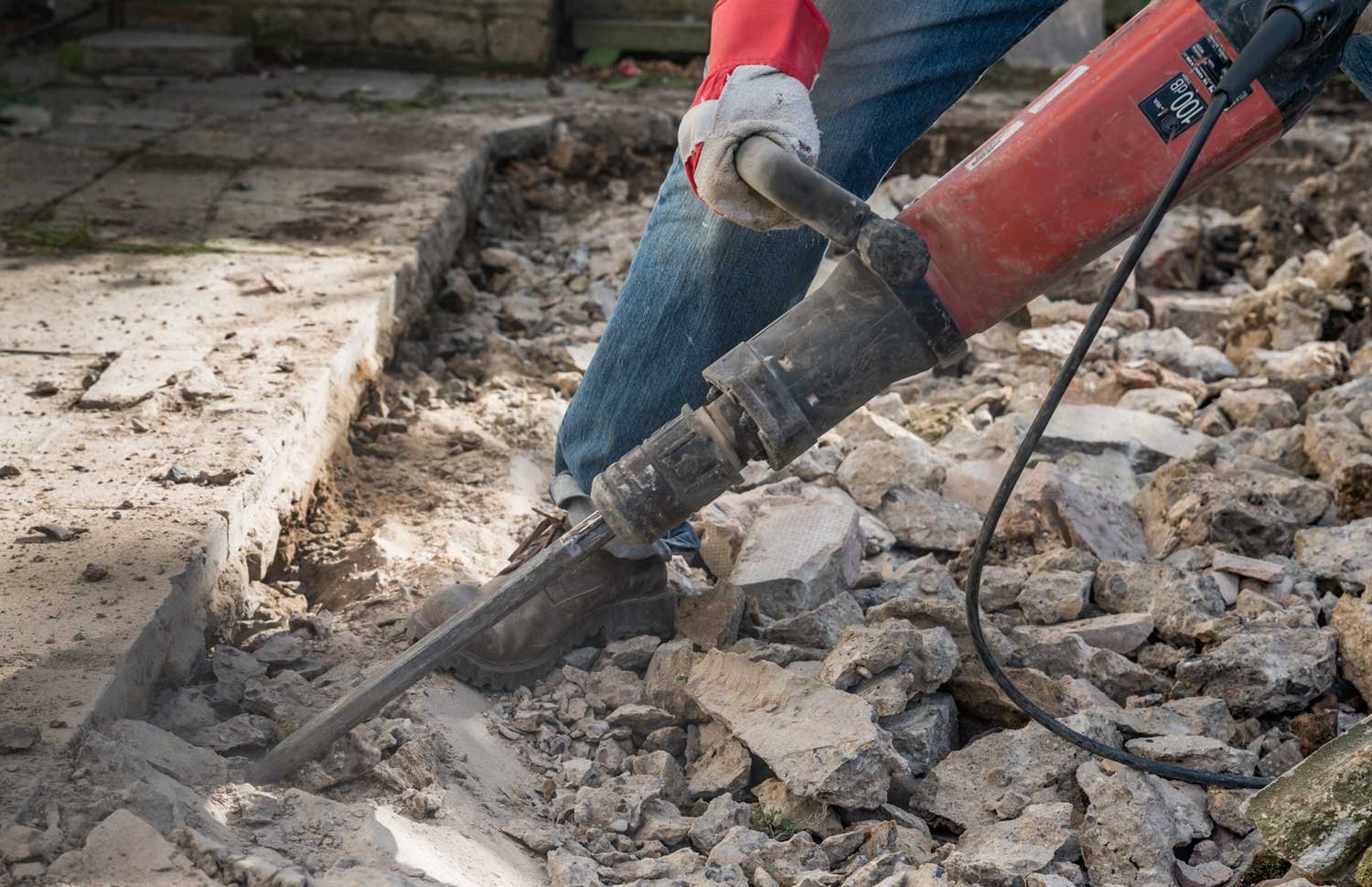
Every job starts with a plan for the cut lines. We locate rebar, post-tensioning, embedded conduit and drains by scanning and review of drawings, then mark cut lines and saw them to a controlled depth so the edge of the remaining slab stays clean. Breaking is done with hydraulic breakers or hoe rams sized to the slab and surrounding conditions, and the pieces are loaded and hauled to a recycling site where possible.
With the old floor out, we test the subgrade. Soft spots, voids and wet clay are excavated and replaced with compacted structural fill or stabilized base. Underground pipes are inspected and repaired before they get buried again. Then we place a vapor retarder if the use requires it, set forms and rebar or fiber reinforcement, and pour new concrete. Joints, dowels and curing are planned for the new loads. Our industrial concrete floors work covers finish tolerance, flatness and surface hardeners.
Dust, noise and what is under the slab
Cutting and breaking concrete creates respirable crystalline silica, and we control it with wet cutting, vacuum-equipped tools, enclosures and respiratory protection, with air monitoring where the exposure calls for it. Noise and vibration are handled with scheduling and sometimes with different breaking methods near sensitive equipment, and we monitor vibration if a neighboring process, lab or precision machine could be affected.
The hidden hazards are underground. Old buildings hide abandoned fuel lines, process sumps, contaminated soil and utility lines. We pothole and scan before cutting, and if something unexpected turns up, work stops in that area until the owner and the right specialist weigh in. In downtown Pueblo, the Union Avenue district sits where the 1921 flood sent water as deep as 18 feet through downtown before the Arkansas River was rerouted, so older basements, fill and buried structures are real possibilities in that part of town.
Phasing a floor while the plant runs
Most owners cannot close a building for a month. We divide the floor into sections that match the crane bays, aisles and process lines, and replace them one at a time. Temporary ramps, steel plates and barriers keep forklifts and people moving around the open area. Product and equipment move to a staging zone and come back when the new slab reaches strength.
Curing time governs everything. Concrete placed Monday cannot carry a loaded truck on Tuesday unless we specify a high-early mix and verify the strength with test cylinders. We plan with the owner what loads go back on the floor and when, and we use maturity testing to open sections earlier when safe. For floors in cold or freezer areas, cold-weather and frost protection add steps, and we plan accordingly.
Timing around production and weather
A section of floor typically takes days from cut to cured, and a large floor takes weeks when sections are staged. Weekends and off shifts are common windows for demolition, because the loud and dusty work is the hardest to run beside production. Concrete placement needs a dry, workable day, and in the Arkansas Valley winter nights can drop below freezing, so we use blankets, heated enclosures or accelerated mixes when needed.
Plan on utilities and inspections too. If new drains or conduit are going under the slab, inspectors need time to approve before the pour. We schedule inspection checkpoints along the way so the pour day is not delayed. Lead times for specialty items such as dowel baskets, hardeners or sealed joint systems are checked at the start.
What drives the price
Slab thickness and reinforcement determine demolition cost, since thick, heavily reinforced floors take longer to cut and break. Access matters too: a floor that equipment can reach directly costs less than one inside a building where all the debris has to be carried through a door. Hauling and disposal depend on the distance to a recycling facility and whether the material is contaminated.
Subgrade repair is the variable. If the soil under the floor is stable, the new slab goes in quickly. If we find voids or soft material, extra excavation and fill add cost. We price base conditions with an allowance and an agreed unit price for added work, so you know what a surprise costs in advance. A compromise is sometimes possible: if only a strip along a dock has failed, replacing that strip and leaving the rest may be right. Related options include new equipment pads and foundations, which we can fold into the same mobilization.
Where the work connects
Slab replacement frequently goes hand in hand with industrial demolition services when a building is being reconfigured. In warehouse buildings, new slabs are often poured to meet tighter flatness tolerances for narrow-aisle racking.
The outdoor version of this work falls under dock aprons and loading zones, where heavy wheel loads are the common cause of failure. In food plants, floors must slope to drains and resist washdown chemicals, so food and beverage owners need careful coordination of finishes.
Fix the floor, not the surface
Send us photos of the failures and the loads they carry. We will walk the floor, probe it and give you a scope and price, with an option to phase the work around your production.
Questions and Answers
Can we resurface instead of replacing the slab?
Sometimes. If the slab is structurally sound and the problem is surface wear, a topping or grinding may be enough. If cracks come from subgrade settlement, curling or poor thickness, resurfacing will fail. We probe the slab and test the subgrade before recommending.
How quickly can the floor go back into service?
With a standard mix, plan for several days before light traffic and longer for heavy loads. High-early mixes shorten that, and cylinder or maturity tests tell us when it is safe. We agree on the loading plan before the pour.
What if we find something under the slab?
We stop work in that area and identify it. Many finds, such as an old drain or void, are routine and fixed in place. Contaminated soil or an unknown tank calls for a specialist and a new plan.
Do you need to remove the whole floor?
Not always. Section replacement keeps cost down when only part of the floor has failed. We map the damage and the loads and propose the smallest area that gives a lasting repair.
How do you control dust and noise?
Wet cutting, vacuum tools, barriers and respirators handle dust. For noise, we shift loud work to off hours and use methods that suit the surroundings. We discuss limits with you and neighbors at the start.
Related
Ready to talk about your project?
Tell us about the site, the heaviest loads and the date that matters. We will review the scope and follow up with next steps for your Pueblo project.